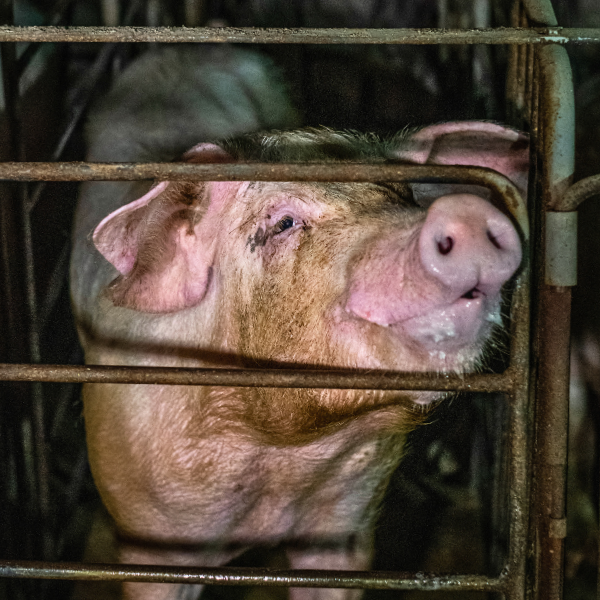
Photo credits: We Animals
In Quebec, we take great care with how we prepare our food. We take pride in our local products. We cook thoughtfully. We serve our friends and families with love.
Photo credits: We Animals
In Quebec, we take great care with how we prepare our food. We take pride in our local products. We cook thoughtfully. We serve our friends and families with love.
Animals used in agriculture are excluded from the most basic protections of Quebec’s animal welfare law, so long as they are treated according to standard industry practices. While detailed regulations exist to protect dogs, cats, and other animals, the living conditions of farmed animals remain unregulated. And there are no proactive government conducted inspections on farms to ensure their wellbeing.
With a provincial election approaching, political parties are deciding what to include in their election promises. Together, we can ensure that farmed animals don’t get left behind.
Improving farmed animal welfare isn’t just about compassion. It’s about public health. Consumer trust. Rural vitality. The long-term success of Quebec’s agricultural sector. And our values as a society.
Across industries, from researchers and animal welfare scientists to producers and butchers, there is clear agreement: raising animals well is not only possible, it also strengthens businesses, protects consumers, and builds confidence in our food system.
Photo credits: We Animals
Me Sophie Gaillard
Director of Animal Advocacy and Legal and Government Affairs,
Montreal SPCA
Jamie Dallaire
Associate Professor, Department of Agricultural and Food Sciences, Université Laval
Vincent Breton
President and CEO, duBreton
Pork producer
Charles Lefebvre
Butcher, La Petite Patrie Butcher Shop
Marion Desmarchelier, DMV, MSc, DACZM, DECZM (ZHM), DACVB, Associate Professor – Department of Clinical Sciences, Faculty of Veterinary Medicine – University of Montreal
Claudia Gilbert, veterinarian and presenter
Enid Stiles DVM MSc

In 2026, Quebecers will choose the next provincial government. Now is the moment to make it clear: animals raised for food deserve clear, legal protections.
By signing our letter, you are calling on all provincial political parties to commit to regulating on-farm animal welfare and to support producers in their transition to higher welfare systems.
Without political commitment, nothing changes. With enough public support, everything can.
Together, let’s change the recipe!
The vast majority of the hundreds of millions of animals raised for food in Quebec are kept in industrial (or “intensive”) farming conditions, meaning that housing systems and practices are designed to maximize meat, egg or milk production while keeping costs to a minimum.
This type of farming involves housing animals at high densities in closed buildings. Animals are confined to very small spaces, with very little room to move comfortably, adopt natural postures, express their natural behaviours or interact normally with others of their kind. Examples include laying hens kept in cages, sows confined to gestation or farrowing crates, and dairy cows kept in tie stalls.
In 2015, the National Assembly of Quebec unanimously adopted the Act to Improve the Legal Situation of Animals, marking an important turning point in Quebec animal law. The legislation introduced a new provision into the Civil Code of Québec recognizing that animals are not property but rather sentient beings. It also created the province’s first law devoted entirely to animal welfare, the Animal Welfare and Safety Act. However, animals used for agricultural purposes are excluded from the Act’s main protections.
At the time of the 2015 legislative changes, the Minister of Agriculture also promised that regulations governing the welfare of farm animals would be adopted. But 11 years later, no regulations relating to farm animals have yet been enacted.
Section 7 of the Animal Welfare and Safety Act excludes all animals used for agricultural purposes from its main protections, namely those contained in sections 5 (which requires an animal’s owner or custodian to provide them with water, food, shelter, care, etc.) and 6 (which prohibits causing distress to an animal), provided they are treated in accordance with the “generally recognized rules” of the industry.
However, these “rules” are not defined in the Act. As long as a significant portion of the industry uses a particular practice, it is considered consistent with the “generally recognized rules.” In practice, this means the industry itself determines which practices are exempt from the law and therefore permitted.
This is why it is perfectly legal—and even common practice—to castrate a piglet without anesthesia, whereas performing the same procedure on a dog or a cat would be punishable by conviction and even imprisonment.
The exemption in section 7 essentially allows the agri-food industry to regulate itself when it comes to animal welfare, representing an abdication of public responsibility by the government. As a recent report published by the Quebec Observatory on Animal Law concludes: the National Assembly established a legal framework for animal welfare and safety in 2015, but effectively delegated authority over farm animals to the agricultural industry itself. The daily treatment of animals used in agriculture is therefore governed primarily by standards defined and applied by that industry.
The National Farm Animal Care Council (NFACC) is a private organization that oversees the development and revision of codes of practice for the care and handling of farm animals. These codes are national guidelines that reflect recommended animal-rearing practices. However, they do not have the force of law in Quebec and there is no public enforcement or oversight mechanism to ensure compliance. In fact, only Newfoundland and Labrador, Prince Edward Island and Yukon have made adherence to NFACC Codes of Practice mandatory.
Although NFACC members come from different sectors, they are not represented equally. The majority represent agri-food industry interests, which dominate the development of the codes and exert significant influence over their final content. As a result, the standards adopted are often far below what would be necessary to ensure animal welfare and below what has been implemented elsewhere in the world.
Some sectors claim to require producers to comply fully with the Codes of Practice. Even if that is the case, the fact that compliance with certain standards is imposed by the industry itself rather than by government raises several issues. First, compliance is typically verified through industry-run audits rather than independent third-party inspections. Second, penalties for non-compliance are also determined by the industry. Finally, because it is a private monitoring system, it is not subject to the same transparency and accountability requirements as a public oversight system. For example, NFACC is not subject to access-to-information laws, despite receiving public funding.
While there are no regulations governing how animals are treated during their lives on farms, their transport and slaughter are regulated by certain federal and provincial laws.
The transport of animals raised for food is regulated by the federal Health of Animals Regulations and the provincial Animal Welfare and Safety Act. Their slaughter is governed by the Safe Food for Canadians Regulations at the federal level and the Regulation Respecting Food at the provincial level.
No systematic government inspections are carried out to ensure the welfare of animals on farms. The inspection system relies solely on complaints, even though animals are mostly kept inside closed buildings, out of sight of the public.
The only people who might witness mistreatment are therefore individuals who have a personal or financial interest in not harming the operation, such as producers, their family members, employees, veterinarians or other individuals associated with the farm.
In many other parts of the world, particularly in Europe, laws or regulations have been adopted that impose mandatory standards of care for all animals, including those used for agricultural purposes. In Switzerland, for example, detailed regulations have been developed for each species and type of use.
Several practices that animal health and welfare specialists consider to significantly compromise the welfare of farm animals—and that have been banned elsewhere in the world precisely for this reason—are still widespread in Quebec. These practices are also still largely permitted under the Codes of Practice developed by the National Farm Animal Care Council (NFACC), which are drafted by committees composed primarily of industry representatives.
For example, confining animals in extremely small spaces—preventing them from moving freely, adopting comfortable postures, expressing natural behaviours or interacting normally with others of their species—is common practice in most sectors. This is the case for laying hens kept in cages, sows confined to gestation and farrowing crates, and dairy cows kept in tie stalls.
Another type of practice that remains common in Quebec but has been prohibited elsewhere is systematic mutilation without adequate pain control. Calf and lamb castration, lamb tail docking and the partial debeaking of laying hens are commonly performed without any analgesia or anesthesia in Quebec, even though these practices are permitted under Codes of Practice and contradict recommendations from the Canadian Veterinary Medical Association.
Piglet castration is routinely performed in Quebec using a scalpel by the producer when piglets are only a few days old. Since 2016, the NFACC Code of Practice has required the use of analgesia after the procedure, but not anesthesia. However, the Canadian Veterinary Medical Association considers this to be a painful procedure that requires both effective anesthesia and analgesia, regardless of the age at which it is performed.
Surgical castration is currently being phased out across Europe. In Switzerland, the law has required piglet castration to be performed under anesthesia since 2010.
The issue does not stem from producers as individuals, but rather from the system in which they operate. A regulatory framework with prescribed and mandatory standards would benefit producers who already prioritize animal welfare and ensure that all others adopt best practices in a consistent and regulated manner.
Such a framework must also include financial support for farmers to help them transition to farming systems that offer higher standards of animal welfare. This is an integral part of the Montreal SPCA’s recommendations.
A regulatory framework for farm animal welfare would also benefit the agri-food sector. It would strengthen the sector and make it more resilient, increase consumer confidence and enhance the value of Quebec food products, while also opening access to new export markets.
Our call is supported by duBreton, a major Quebec pork producer recognized for its higher animal welfare practices. duBreton’s model demonstrates that giving animals more freedom to express their natural behaviours can go hand-in-hand with a prosperous and competitive business.
Adopting clear regulations and providing financial support to help producers transition to systems that are more respectful of animal welfare would allow Quebec to modernize and strengthen its agricultural sector, increase consumer confidence, enhance the value of Quebec products and gain access to new export markets.
An independent economic impact study conducted by the firm Aviseo found that every dollar of net subsidies allocated to support a transition toward higher-welfare production systems would generate $3.20 in added value for Quebec’s economy over a 10-year period, while supporting more than 6,200 jobs, primarily in rural regions.
The analysis also highlights important structural benefits for the provincial economy, including increased productivity, the development of a stronger Quebec brand and improved access to export markets such as the European Union. The study concludes that it would be desirable for the government to implement a support program to help Quebec farms transition toward higher-welfare production systems, as the economic and fiscal benefits generated by these investments would largely outweigh the initial costs while improving the welfare of farm animals.
Regulating farm animal welfare and ensuring higher welfare standards can help protect against the development and spread of disease while reducing reliance on antibiotics.
Intensive farming systems reduce genetic diversity and subject animals to chronic stress, making herds more vulnerable to disease. High stocking densities and long-distance transport also facilitate the spread of pathogens, increasing the risk of epidemics. Intensive farming has been associated with viruses capable of mutating and infecting humans, including highly pathogenic avian influenza (H5N1).
Improving animal welfare—particularly by reducing stocking densities and improving living conditions—can reduce viral loads and limit the risk of zoonotic disease transmission.
The World Health Organization identifies antimicrobial resistance as one of the ten greatest threats to global public health. Globally, approximately 70% of medically important antibiotics are administered to animals to prevent disease in intensive farming systems. Excessive antibiotic use contributes to the emergence of resistant bacteria that can spread to humans through food, water or direct contact.
Reducing preventive antibiotic use therefore requires improving animals’ living conditions. Lower stocking densities, improved hygiene and outdoor access strengthen animals’ immune systems and reduce reliance on preventive treatments.
Intensive farming systems generate large volumes of manure, which can pose risks to workers, nearby communities and ecosystems.
Excess nutrients can contaminate water sources and damage aquatic ecosystems. Intensive livestock operations also emit methane and nitrous oxide, two powerful greenhouse gases. Production methods that provide better animal welfare and operate at lower densities can reduce pollution pressures and environmental risks.
Since 2022, the United Nations Environment Assembly has recognized that animal welfare can contribute to addressing environmental challenges and achieving sustainable development goals.
Shouldn’t consumers simply choose products produced using higher-welfare methods if they are concerned about this issue? Why should the government intervene?
The responsibility for ensuring that food produced in Quebec aligns with our collective values should not fall solely on consumers. It is the responsibility of the state to ensure that all animals, including those used in agriculture, benefit from basic legal protections.
This responsibility has in fact been explicitly recognized by Quebec lawmakers. In its preamble, the Animal Welfare and Safety Act states that “human beings have an individual and collective responsibility to ensure the welfare and safety of animals,” and that “the State considers it essential to intervene in order to establish an effective legal and administrative framework to ensure the welfare and safety of animals.”
There is broad scientific consensus that farm animals are just as capable of feeling pain and suffering as our dogs, cats and other companion animals. As research advances, science continues to show that many animals possess far more complex cognitive and emotional abilities than previously understood—and this applies just as much to dogs and cats as it does to cows, pigs, chickens and other mammals and birds raised for food.
It is therefore necessary to take the interests and needs of all animals into account in the way we treat them.
Although animals raised for food are sentient beings with complex cognitive and emotional capacities, their systematic exclusion from the law’s main protections means that many practices that cause suffering remain permitted—even though those same practices would be considered criminal if performed on dogs or cats, for example.
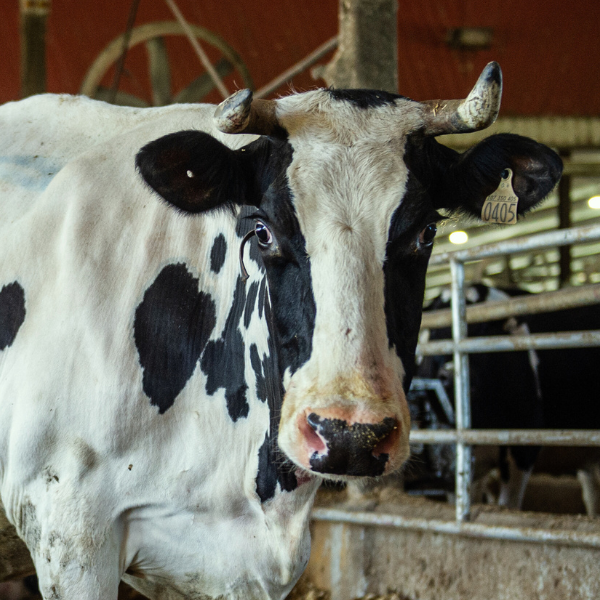
Photo credits: We Animals
At the time of the 2015 legislative changes, the Minister of Agriculture also promised that regulations governing the welfare of farm animals would be adopted.